
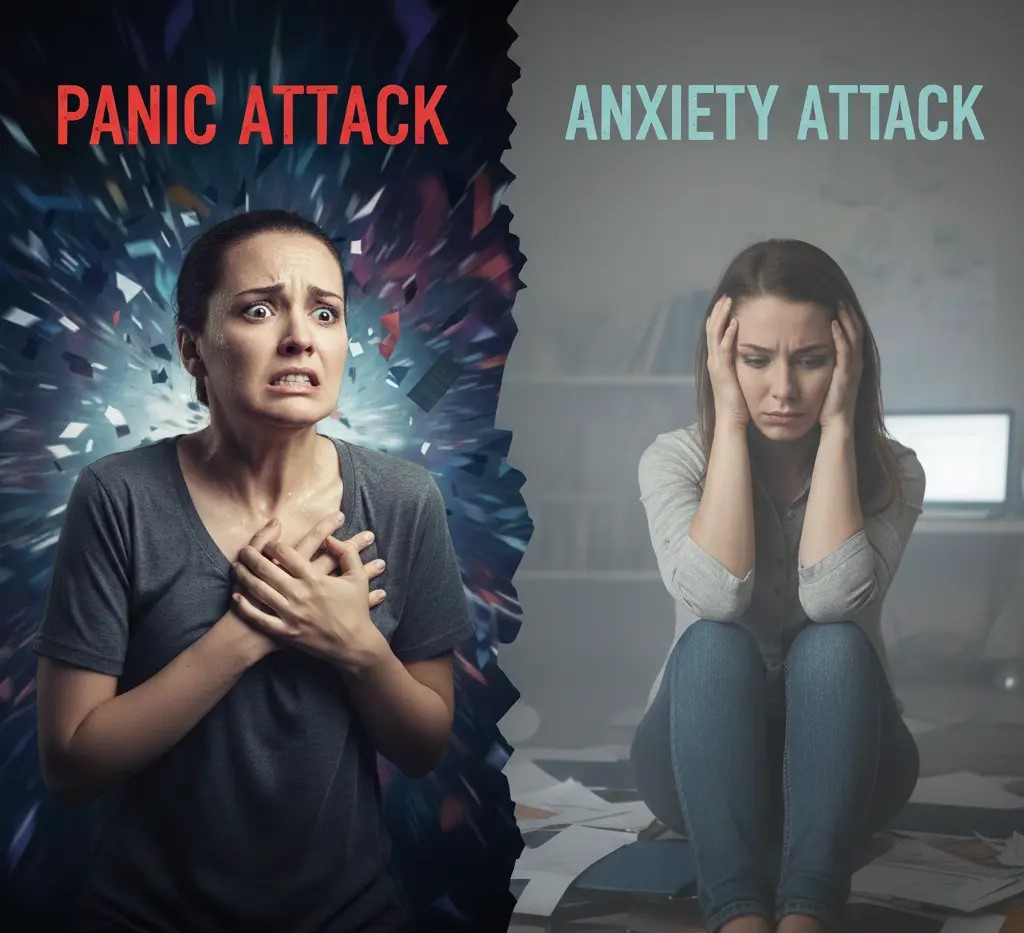
You are not alone in that you may have experienced a sudden fear or your heart may have felt like it was racing or you might have felt that something bad was about to occur. Individuals go through situations such as this and they instantly ask themselves why something is wrong. Naturally, one of the most searched questions online is panic attack vs anxiety attack.
The two terms are not identical despite the fact that they are used interchangeably. Knowing the difference will make you feel less frightened and more in control. More to the point, it is able to lead you to the appropriate type of support.
In this article, we are going to take all of it apart in an easy and simple manner- no medical jargon and misunderstanding.
What Is a Panic Attack?
The panic attack suddenly comes. One moment you are okay, and the next moment you feel your heart beating wildly with the extreme fear. By virtue of this, panic attacks are usually shocking and overwhelming.
The typical symptoms of the panic attacks are:
- A pounding or racing heart
- Shortness of breath
- Chest tightness or pain
- Dizziness or nausea
- Sweating or shaking
- The fear of being out of control or dying.
Panic attack is not dangerous, though these symptoms seem to be very serious. Mental health experts state that it is the hyper-reaction of the body to the perceived danger. Nevertheless, it is a frightening experience, particularly when it occurs the first time.
What Is an Anxiety Attack?
The anxiety attack is not similar in speed or intensity. Anxiety does not come abruptly as time goes by. Most of the times it is associated with prolonged anxiety or concern.
The typical symptoms of anxiety attack are:
- Constant worrying
- Feeling tense or on edge
- Trouble focusing
- Fatigue
- Muscle tightness
- Difficulty sleeping
Anxiety attacks are caused by certain issues like work, health or relationship issues unlike the panic attacks which are not always correlated with these problems. Due to this, most individuals do not even notice that they have been anxious until the symptoms are too many to cope.
Panic Attack vs Anxiety Attack: What’s the Difference?
Understanding panic attack vs anxiety attack becomes easier when you compare them directly. Although both of them influence mental health, the same does not apply.
How They Start
As a condition, panic attacks are rapid and reach their peak in minutes. Conversely, anxiety attacks are chronic and can take hours and even days to resolve.
Intensity Level
Panic attacks are severe and terrifying. Anxiety attacks are uncomfortable and are normally not so severe.
Triggers
The panics may occur with no apparent cause. The anxiety attacks are normally triggered by something.
Physical vs Mental Symptoms
Panic attacks are very physically manifested. The anxiety attacks are more concentration on mind distress and tension.
The Reason Behind the similarity of Panic Attacks and Anxiety Attacks.
Confusion is a common occurrence regardless of their differences. It is so because they both entail the stress response of the body. Stress hormones are released when your brain perceives danger of some sort, actual or imaginary.
Because of this, you get your heart going, breathing turns and fear rises. Because of these shared reactions, people often search for panic attack vs anxiety attack symptoms when trying to understand their experience.
Normal Causes and Risk Factors.
The risk factors are similar in both panic and anxiety attacks. Not all people do feel them equally, however.
Common causes include:
- Ongoing stress
- Past trauma
- Anxiety disorders were present in the family history.
- Major life changes
- Excessive caffeine
- Poor sleep habits
Also, failure to rest and disregard of emotional needs may deteriorate symptoms with time.
Diagnosis of Panic and Anxiety attacks by Doctors.
Detailed interviews are employed by mental health professionals to know about symptoms. Another finding is that they use clinical guidelines of reputable sources.
Physical illnesses including heart problems are sometimes eliminated by doctors. This is also necessary since the symptoms of panic are usually physical. Effective treatment is achieved by having a proper diagnosis.
Effective Treatment Alternatives That Work.
The positive fact is that the treatment is working. The proper approach makes the majority of people feel much better.
Therapy
One treatment that has the greatest efficacy is Cognitive Behavioral Therapy (CBT). It teaches you to recognize the way of thinking and create better reactions.
Medication
There are those who respond to medication, including SSRIs. Nevertheless, therapy supplemented by medication is optimal.
Healthy Lifestyle Changes
Fitness helps in eliminating stress. The breathe in exercises relax the nervous system. Caffeine reduction is also a measure to reduce symptoms.
Easy Coping Techniques You Can Put into Practice.
Although professional assistance is essential, everyday coping resources may prove quite helpful.
- Helpful strategies include:
- Slow, deep breathing
- Grounding exercise
- Writing about anxious thoughts.
- Maintaining a routine
- Decreasing the amount of time on the screen before going to bed.
In the long-run, such habits are capable of reducing the number and severity of attacks.
In Which Cases can you need a professional assistance?
When panic or anxiety attacks begin to disrupt the normal life, it is time to seek assistance. No one can do away with frequent episodes and avoidance behaviors or constant fear.
Mental health workers possess the training and experience to take the right path to recovery. The sooner the support is provided, the better.
Conclusion
Understanding panic attack vs anxiety attack can change how you view your symptoms. You become more clear and confident as opposed to being afraid of the unknown. Though the two experiences are traumatic, they can be dealt with.
Can the healing work? With the correct information, adequate support, and self-care, then the healing can be done. Above all things you are not weak–you are not alone.
FAQ’s
1. Can a panic attack turn into an anxiety attack?
Not exactly. Anxiety may, however, progress to a panic attack due to continuous anxiety. They feel similar, but at the same time, they are two different experiences.
2. Panic attack or anxiety attack, which is the more serious one?
No one of them is more serious than the other. Both can affect daily life. The effects can be determined by the frequency of their occurrence and the intensity.
3. What is the average duration of a panic attack?
The majority of panic attacks are highest in 10 minutes. Nevertheless, some of the longer-lasting effects such as fatigue can persist.
4. Is it possible to experience anxiety attacks on a daily basis?
Yes, anxiety attacks may be quite numerous particularly when one is going through stressful times. Dealing with stress enables decreasing the occurrence of stress.
5. Would you send me to the ER because I have a panic attack?
In case of the first time or unusual symptomatology, it is useful to seek medical attention. Panic attacks normally do not necessitate emergency attention once diagnosed.
6. Will therapy be of help in panic and anxiety attacks?
Yes. Therapy, and in particular CBT, is shown to make people see triggers and have control over the symptoms.