
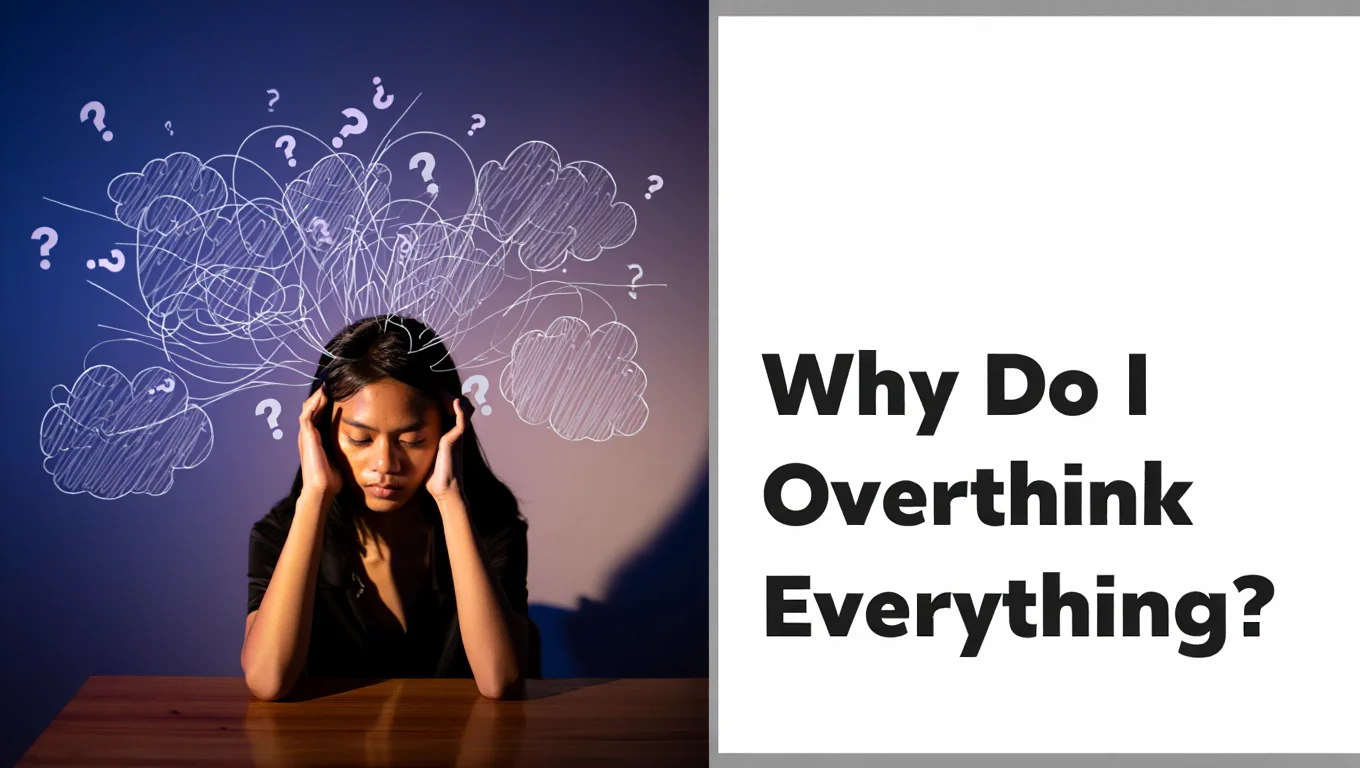
Do you replay conversations in your head hours after they happen? Do you lie awake at night running through every possible thing that could go wrong tomorrow? If so, you are not alone, and you are not broken.
Overthinking is one of the most common mental struggles people face today. It quietly drains your energy, clouds your judgment, and keeps you stuck in a loop of worry that feels impossible to escape. The frustrating part? The more you try to stop, the louder the thoughts seem to get.
This article is here to help. At Psych Lounge, we believe that understanding your mind is the first step to healing it. So let us break down why you overthink everything, what it does to your mental health, and most importantly, how you can start to take back control.
What Is Overthinking?
Overthinking, also known as rumination, is the habit of getting stuck in repetitive, negative thought patterns. It goes beyond normal reflection or problem-solving. When you overthink, your mind does not simply think through a problem and move on. Instead, it circles back to the same thoughts again and again, often making the situation feel far worse than it actually is.
There is a clear difference between thinking something through and overthinking it. Healthy thinking leads to action or resolution. Overthinking leads to paralysis, self-doubt, and emotional exhaustion.
Research shows just how common this experience is. According to a study by sociologist Susan Nolen-Hoeksema, nearly 73% of adults aged 25 to 35 and 52% of adults aged 45 to 55 experience overthinking regularly. Interestingly, the tendency decreases with age, with only about 20% of people over 60 identified as consistent overthinkers
Why Do I Overthink Everything?
This is one of the most searched questions in mental wellness, and the answer is not simple. Overthinking rarely has just one cause. It usually stems from a combination of psychological habits, life experiences, and emotional patterns.
Stress and uncertainty are among the most common triggers. When life feels unpredictable or overwhelming, the mind tries to compensate by running through every possible outcome. It feels like preparation, but it often creates more anxiety instead of relief.
Low self-confidence also plays a big role. When you do not trust your own judgment, you second-guess your decisions constantly. You replay what you said, wonder how others perceived you, and question whether you made the right choice, even for small everyday matters.
Past trauma or difficult experiences can wire the brain into a state of chronic alertness. If you have been hurt, embarrassed, or blindsided before, your brain learns to scan for danger, which often shows up as overthinking.
Perfectionism is another powerful driver. When you hold yourself to impossibly high standards, every decision feels high-stakes. Every mistake becomes evidence of failure. This creates a cycle of over-analysis that is hard to break.
Anxiety disorders can also fuel excessive overthinking. The two are closely connected, which we will explore more below.
Signs You Are Overthinking Too Much
Overthinking does not always look dramatic. Sometimes it sneaks into daily life in subtle ways. Here are the most common signs that your thinking has crossed into overthinking territory:
- You struggle to make even simple decisions, like what to eat or what to wear
- You replay past conversations and mentally edit what you should have said
- You imagine worst-case scenarios before anything has even happened
- You need constant reassurance from others before moving forward
- You find it difficult to concentrate because your mind is always busy
- You frequently miss deadlines because you cannot stop second-guessing yourself
- You feel mentally exhausted even after a full night of sleep
- You avoid situations just to prevent the anxiety of overthinking them
If several of these feel familiar, your mind may be working overtime in ways that are holding you back.
Overthinking and Anxiety: How They Are Connected
Overthinking and anxiety are deeply linked, and one often feeds the other. Anxiety tends to produce intrusive, fearful thoughts. Overthinking is the habit of dwelling on those thoughts rather than letting them pass.
When you overthink, your nervous system interprets that mental activity as a real threat. Your body responds with physical symptoms like a racing heart, muscle tension, shallow breathing, and restlessness. This is why overthinking and anxiety symptoms often appear together.
Research also shows that chronic rumination significantly increases the risk of developing depression and generalized anxiety disorder. It is not just a bad habit. Over time, overthinking can genuinely affect your mental health by reinforcing negative thought patterns and making it harder for the brain to regulate emotions.
Common overthinking patterns that fuel anxiety include:
- Catastrophizing: Assuming the worst will always happen
- All-or-nothing thinking: Seeing situations as either perfect or a total disaster
- Overgeneralizing: Letting one bad experience define every future outcome
- Mind reading: Assuming you know what others are thinking about you
Recognizing these patterns is a powerful first step toward breaking them.
Why Do I Overthink Everything at Night?
If your mind goes into overdrive the moment your head hits the pillow, there is a good reason for it. During the day, you are busy. Work, conversations, tasks, and screens all keep the mind occupied. But at night, when the distractions fade away, your brain finally has the quiet space to process everything it did not get to during the day.
The problem is that the brain does not always use that quiet space wisely. Without the grounding structure of daily activity, anxious and unresolved thoughts rise to the surface. This is why so many people experience their worst overthinking episodes at night.
Nighttime overthinking often involves:
- Replaying events from the day
- Worrying about what is coming tomorrow
- Feeling regret over past decisions
- Running through hypothetical scenarios that may never happen
This kind of mental activity makes it nearly impossible to fall asleep, which then creates a new problem: sleep deprivation, which makes overthinking even worse the next day.
How to Stop Overthinking and Anxiety
There is no single switch to turn off overthinking, but there are proven strategies that genuinely help. Here are practical steps you can take to quiet your mind and reduce anxiety.
1. Notice when you are doing it. Awareness is the first step. When you catch yourself spiraling, simply name it. “I am overthinking right now.” This small act creates a tiny pause between the thought and the reaction.
2. Schedule a worry time. Instead of fighting your thoughts all day, set aside 15 to 20 minutes to deliberately think about your worries. Outside of that window, when an anxious thought appears, remind yourself you will deal with it during worry time. This teaches your brain that not every thought needs immediate attention.
3. Practice grounding techniques. The 5-4-3-2-1 technique is especially helpful. Name 5 things you can see, 4 you can touch, 3 you can hear, 2 you can smell, and 1 you can taste. This pulls your attention out of your head and back into the present moment.
4. Break the routine that feeds overthinking. If certain situations consistently trigger your spiraling thoughts, plan a different response. Go for a walk, call a friend, or shift your environment. Replacing the overthinking habit with a healthier one gradually weakens its grip.
5. Challenge your thoughts with facts. Ask yourself: “Is this thought based on facts or feelings? What is the actual evidence for and against this?” This cognitive reframing technique is a cornerstone of CBT for anxiety and is highly effective for stopping negative thought spirals.
How to Calm an Overthinking Mind Fast
Sometimes you need relief right now. These quick strategies can help calm an overthinking mind in minutes:
- Box breathing: Inhale for 4 counts, hold for 4, exhale for 4, hold for 4. Repeat several times.
- Cold water: Splashing cold water on your face activates the body’s calming response.
- Physical movement: A short walk or even jumping jacks can physically interrupt a thought spiral.
- Write it down: Transferring your thoughts onto paper gets them out of your head and makes them feel more manageable.
- Focus on what you can control: Ask yourself, “What is the one thing I can actually do right now?” Action, even a small one, breaks the overthinking cycle.
Overthinking Causes and Solutions
Here is a quick summary of the main causes and their matching solutions:
Cause: Stress and uncertainty. Solution: Practice acceptance and focus on what is within your control
Cause: Low self-confidence. Solution: Build self-trust through small, consistent decisions and positive self-reflection
Cause: Perfectionism. Solution: Embrace “good enough” and reframe mistakes as learning opportunities
Cause: Anxiety. Solution: Use breathing techniques, grounding, and consider professional support
Cause: Past trauma. Solution: Work with a therapist to process unresolved experiences
Cause: Nighttime quiet. Solution: Create a wind-down routine that limits screen time and includes journaling or relaxation exercises
Is Overthinking a Mental Health Problem?
This is an important question, and the honest answer is: overthinking itself is not a diagnosable mental health disorder. It is a pattern of thought, not a clinical condition.
However, that does not mean it is harmless. Research consistently shows that chronic overthinking is a significant risk factor for depression and anxiety. It can also be a symptom of existing conditions like generalized anxiety disorder, OCD, PTSD, and depression, which is why a proper psychological assessment is often the most helpful first step.
Think of overthinking like high blood pressure. It is not a disease in itself, but left unaddressed, it significantly raises your risk for something more serious. Taking it seriously is a form of self-care, not overreacting.
When to Seek Professional Help
There are times when overthinking goes beyond what self-help strategies can address, and structured therapy sessions can make all the difference. It may be time to talk to a mental health professional if:
- Overthinking is interfering with your work, relationships, or daily functioning
- You feel like you have no control over your thoughts
- You are experiencing physical symptoms like chronic insomnia, headaches, or chest tightness
- You notice signs of depression, such as low mood, loss of interest, or hopelessness
- Your overthinking is connected to a traumatic experience
- You have tried self-help strategies and they are not working
Reaching out is not a sign of weakness. Working with a professional through individual therapy can help you understand the root cause of your overthinking and build strategies that are tailored specifically to you. Cognitive Behavioral Therapy (CBT) in particular has a strong evidence base for treating rumination, anxiety, and the thought patterns that drive overthinking.
Conclusion
If you have been asking yourself “why do I overthink everything?”, we hope this article has given you both clarity and comfort. Overthinking is incredibly common, deeply human, and absolutely possible to manage.
You do not have to white-knuckle your way through a mind that never quiets down. Small, consistent steps like noticing your patterns, practicing grounding, challenging your thoughts, and building healthier routines can make a real difference over time.
And if it ever feels like too much to handle alone, please know that support is available. You deserve a mind that feels calm, clear, and free from the weight of constant worry. That is exactly what Psych Lounge is here to help you build.